
Introduction
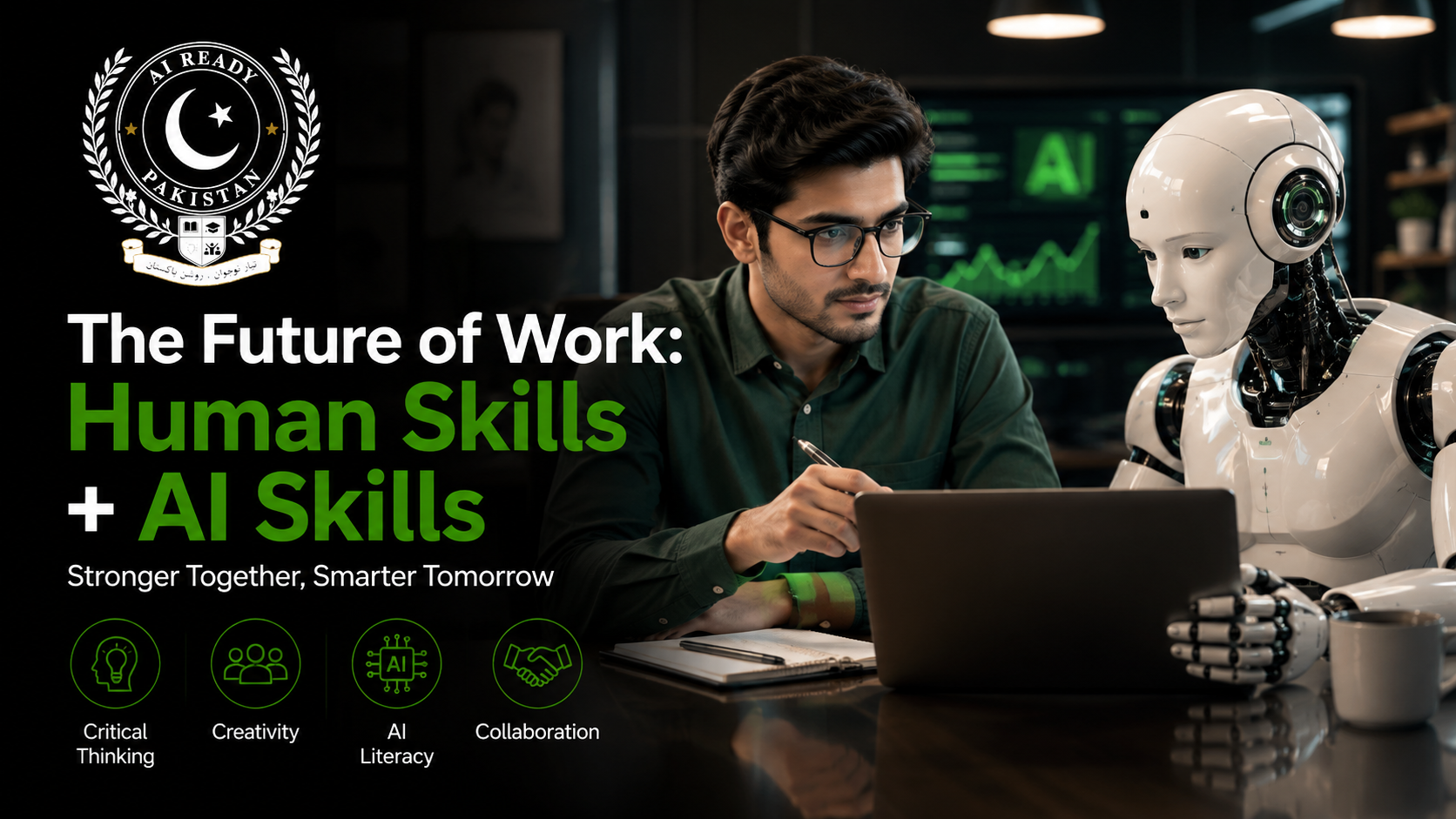
The workplace is changing fast. AI is automating routine tasks and reshaping how people work across nearly every industry. But the future isn’t about AI replacing people; it’s about people who can combine human skills with AI skills. Organizations aren’t just looking for AI expertise; they want people who can use AI as a tool while still bringing creativity, empathy, and critical thinking to the table. The future of work is a partnership, not a competition.
The Rise of AI in the Workplace
AI is now a core part of modern business in healthcare, education, finance, agriculture, and manufacturing. It analyzes data, automates repetitive tasks, and supports decision-making. Chatbots handle customer support, AI helps doctors diagnose faster, and intelligent systems optimize supply chains.
The World Economic Forum expects millions of jobs to evolve because of AI and automation in the coming years. Some traditional roles may fade, but new careers AI trainers, prompt engineers, data analysts, AI ethicists are emerging just as fast. This shift is exactly why workers need both technical and interpersonal skills going forward.
Why Human Skills Still Matter
AI processes information quickly, but it can’t replicate human judgment, emotion, or ethics. These human skills remain the foundation of any strong career:
1. Critical Thinking AI can generate answers, but humans still need to judge whether those answers are accurate and reliable.
2. Creativity and Innovation AI generates ideas based on existing data, but it can’t originate genuinely new concepts the way people can. This still drives product development, storytelling, and entrepreneurship.
3. Communication Explaining ideas clearly, negotiating, and building relationships all require real human interaction. AI can assist with writing, but it can’t replace the conversation itself.
4. Emotional Intelligence Empathy, leadership, and conflict resolution are things machines simply don’t have. These skills are what help teams stay motivated, and workplaces stay healthy.
5. Adaptability As tools keep changing, the professionals who keep learning and adjusting will stay ahead of the curve.
Essential AI Skills for the Future
Alongside human skills, professionals also need practical AI competencies:
1. AI Literacy – Understanding what AI is, how it works, and where its limits are not becoming a programmer, just knowing how to use it well.
2. Prompt Engineering – Knowing how to write clear, specific prompts to get better results from AI tools, whether for research, writing, or design.
3. Data Literacy – Since data fuels AI, knowing how to interpret and evaluate it helps professionals make smarter decisions and spot misleading information.
4. Digital Collaboration – Comfort with AI-powered productivity tools and virtual collaboration platforms is now a basic workplace skill.
5. Ethical Use of AI – Protecting privacy, avoiding bias, and using AI transparently, employers increasingly value people who take this seriously.
The Right Combination: Human + AI Skills
The most successful professionals won’t rely purely on AI or purely on traditional skills; they’ll combine both:
- A teacher can use AI to build lesson plans, while using empathy to actually connect with students.
- A doctor can use AI for faster diagnosis, while relying on judgment and compassion to treat patients well.
- A marketer can generate content ideas with AI, while applying strategy and creativity to make campaigns actually land.
- A business leader can use AI-generated insights, while still making ethical, long-term decisions for their organization.
This combination boosts productivity without losing the human qualities organizations value most.
Preparing Students for the Future
Universities and training programs need to prepare students for AI-driven workplaces by pairing technical skills with soft-skill development. Students should focus on:
- Learning AI tools and digital technologies
- Strengthening communication and presentation skills
- Building critical and creative thinking
- Practicing teamwork and leadership
- Solving real-world problems through hands-on projects
- Developing a mindset of lifelong learning
Interdisciplinary education blending technical knowledge with human-centered skills will matter more than ever.
Challenges and Opportunities
AI adoption isn’t without friction. Some workers fear job displacement; others struggle to keep up with fast-changing tools. But history shows technological shifts tend to create new opportunities alongside the disruption.
Workers who keep upgrading their skills will be better positioned for what’s coming. Governments, institutions, and businesses all have a role to play in providing the training and reskilling programs that make this transition fair for everyone, not just those who already have access.
Conclusion
The future of work isn’t about choosing between humans and AI it’s about combining the strengths of both. AI brings speed, scale, and efficiency. Humans bring creativity, empathy, and judgment. The professionals who build both sets of skills will be the most valuable in tomorrow’s workforce.
Lifelong learning isn’t optional anymore; it’s the baseline. Those who embrace AI while sharpening their human abilities won’t just stay relevant; they’ll help shape what comes next. Success will belong to people who see AI not as a threat, but as a genuine partner in doing better, more meaningful work.
About AI Ready Pakistan
Our mission is to make every student AI-ready and professionally competitive in today’s world through limited scholarship-based training for 5,000 students, led by top trainers.
📩 Get Involved:
🔹 Join the Trainings → https://forms.gle/aY81cQAHesNMeHTq5
🔹 Become a Trainer → https://forms.gle/v9BMrW9EMsWJPQwf7
🔹 Join the Advisory Council → https://forms.gle/Hj76iXs3MkNcyabz9
🔹 Become a Support Partner → https://forms.gle/q1YKKwUaUY5mps7W6
📧 aireadypakistan@gmail.com | 📞 +92 315 9103387