
Introduction
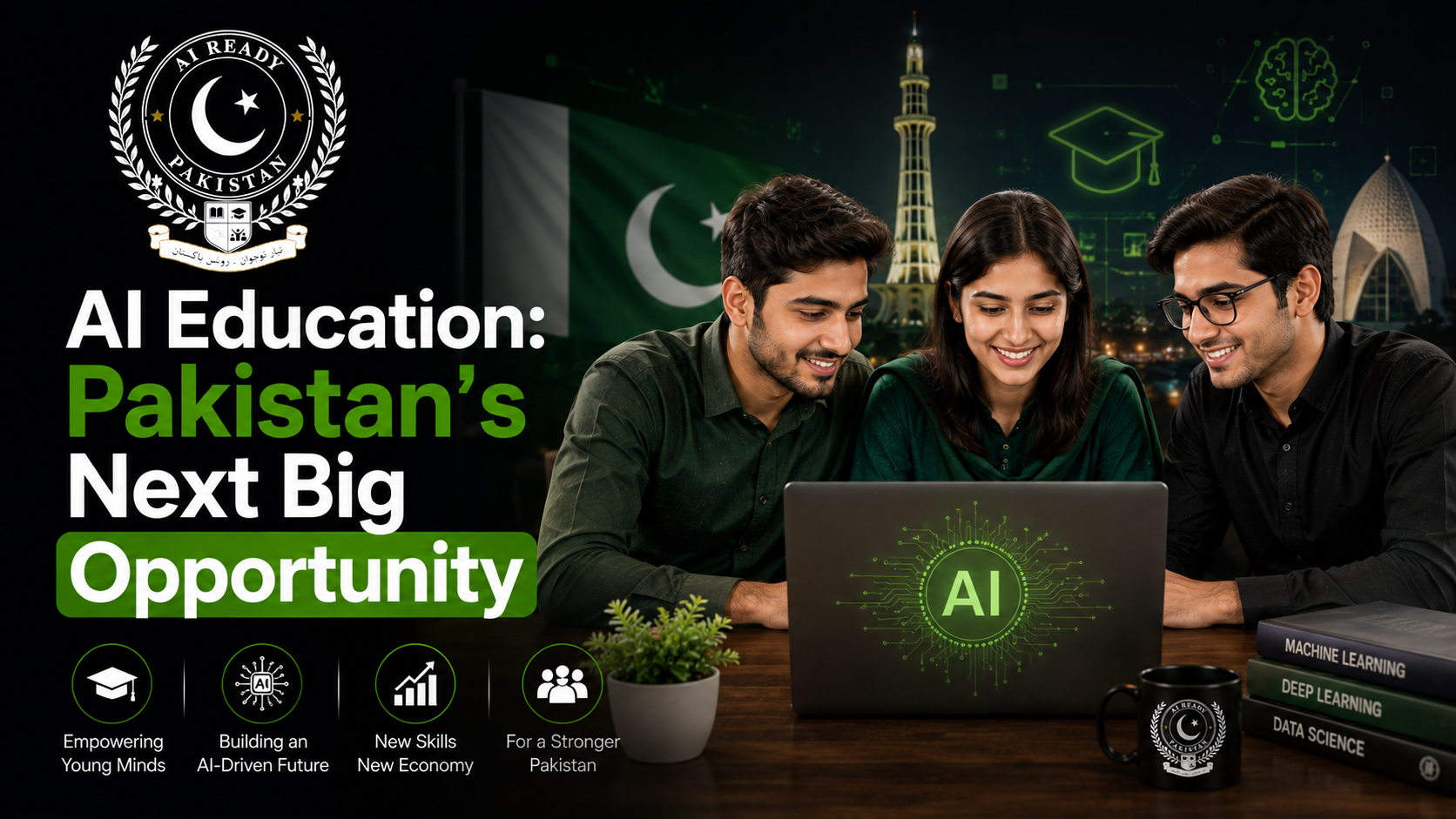
Artificial Intelligence is changing how people learn, work, and solve problems. For Pakistan, this isn’t just a tech trend; it’s a real opportunity to improve education, build a skilled workforce, and connect young Pakistanis to the global economy.
Pakistan has one of the world’s largest youth populations, a genuinely valuable resource. But a young population alone isn’t enough. Students need relevant skills, universities need to modernize, and organizations need people who can actually work with new technology. That’s exactly why AI education matters right now.
Why AI Education Matters for Pakistan
AI is already reshaping healthcare, finance, agriculture, education, and business. As more organizations adopt AI tools, the nature of many jobs is shifting with them.
The World Economic Forum’s Future of Jobs Report 2025 estimates that 39% of workers’ existing skills could become outdated between 2025 and 2030. In other words, a degree alone no longer guarantees long-term relevance. Students need to keep building new skills continuously.
This makes it urgent for Pakistan to make AI education available beyond computer science departments. A student studying English, business, medicine, law, media, or agriculture can benefit from understanding how AI applies to their own field. AI shouldn’t be treated as a niche subject for tech enthusiasts; it should be part of everyday digital literacy.
How AI Education Empowers Students
Students stand to gain the most from AI education. Learning AI can help with research, organizing information, analyzing data, and improving writing, but more importantly, it teaches students to use AI critically instead of blindly copying whatever a chatbot produces.
That distinction matters. Real AI literacy isn’t just knowing how to write a good prompt; it’s knowing how to verify AI output, recognize bias, protect privacy, and still think independently.
These skills also open real career paths in AI-assisted marketing, data analysis, educational technology, and AI-supported business operations, to name a few. UNESCO has noted that AI can help address major challenges in education, but stresses that this only works if it’s paired with inclusion, equity, and a human-centered approach.
Universities Need to Catch Up
Universities have a real role to play here. Rather than treating AI as purely a computer science topic, they can weave AI literacy across disciplines — business students learning AI-powered analytics, media students exploring AI-assisted content creation, medical students studying healthcare applications, and law students examining AI regulation and privacy.
Universities can also build AI clubs, innovation labs, and interdisciplinary projects that let students actually experiment, not just read about AI in theory.
Teachers need training too. UNESCO has already built AI competency frameworks for both students and educators; the goal isn’t to replace teachers with AI, but to help them use it as a tool that strengthens teaching without losing the human element.
What This Means for Organizations
Businesses benefit from AI-literate employees too people who can automate repetitive work, analyze information faster, and spot new ways to solve problems. Investing in training now is smarter than waiting until an entire workforce falls behind.
This matters especially for Pakistani companies competing internationally. AI can help smaller organizations access capabilities that used to require much bigger teams.
The World Bank has found that developing economies may actually face less employment disruption from AI than advanced economies, while still gaining real productivity benefits as long as they invest in digital skills, infrastructure, and access. For Pakistan, that means AI education needs to connect to real economic needs, not stop at a certificate.
Beyond Protecting Jobs, Creating New Ones
AI education isn’t just about protecting existing careers; it can create entirely new ones. Students can use AI skills to launch startups, offer freelance services, or work with international clients, building on Pakistan’s already strong freelancing ecosystem.
But there’s a real risk here too: unequal access to AI education could widen the digital divide. Students with reliable internet and modern devices will move faster than those without — which means Pakistan needs AI education that reaches beyond major cities and elite institutions. Affordable training, public-private partnerships, and accessible digital resources are what will make AI an opportunity for everyone, not just a privileged few.
What Should Students Actually Learn?
Not everyone needs to become an AI engineer. What matters more is building a mix of:
- AI literacy — understanding what AI is and how it works
- Prompting and tool use — using AI effectively for research and productivity
- Critical thinking — checking AI output instead of accepting it blindly
- Digital skills — comfort with data and online platforms
- Creativity — using AI to support original ideas, not replace them
- Communication — presenting ideas and working well with people
- Ethical awareness — understanding privacy, bias, and responsible use
- Continuous learning — staying adaptable as technology shifts
These skills complement almost any degree; they’re not a replacement for one.
Conclusion
AI education is one of Pakistan’s biggest opportunities to prepare its young population for what’s coming. But opportunity doesn’t turn into progress on its own — it takes students willing to learn, universities willing to adapt, and institutions willing to make this accessible to everyone, not just a few.
Pakistan doesn’t need every student to become a programmer. It needs students who understand AI, use it responsibly, and combine it with their own creativity and human judgment.
The future won’t belong entirely to humans or entirely to machines. It will belong to the people who know how to work well with both.
About AI Ready Pakistan
Our mission is to make every student AI-ready and professionally competitive in today’s world, through limited scholarship-based training for 1,000+ students, led by top trainers.
📩 Get Involved:
🔹 Join the Advisory Council → https://forms.gle/Hj76iXs3MkNcyabz9
🔹Become a Support Partner → https://forms.gle/q1YKKwUaUY5mps7W6
📧 aireadypakistan@gmail.com | 📞 +92 315 9103387