
Introduction
The job market is changing. Employers aren’t just looking at degrees and grades anymore; they want proof that candidates can actually apply what they know, solve real problems, and learn independently.
AI makes this shift even more important. As more organizations adopt AI tools, students who can use AI well have a real edge, but simply writing “AI skills” on a CV isn’t enough anymore. You need to show what you can actually do. That’s where an AI portfolio comes in.
Why an AI Portfolio Matters
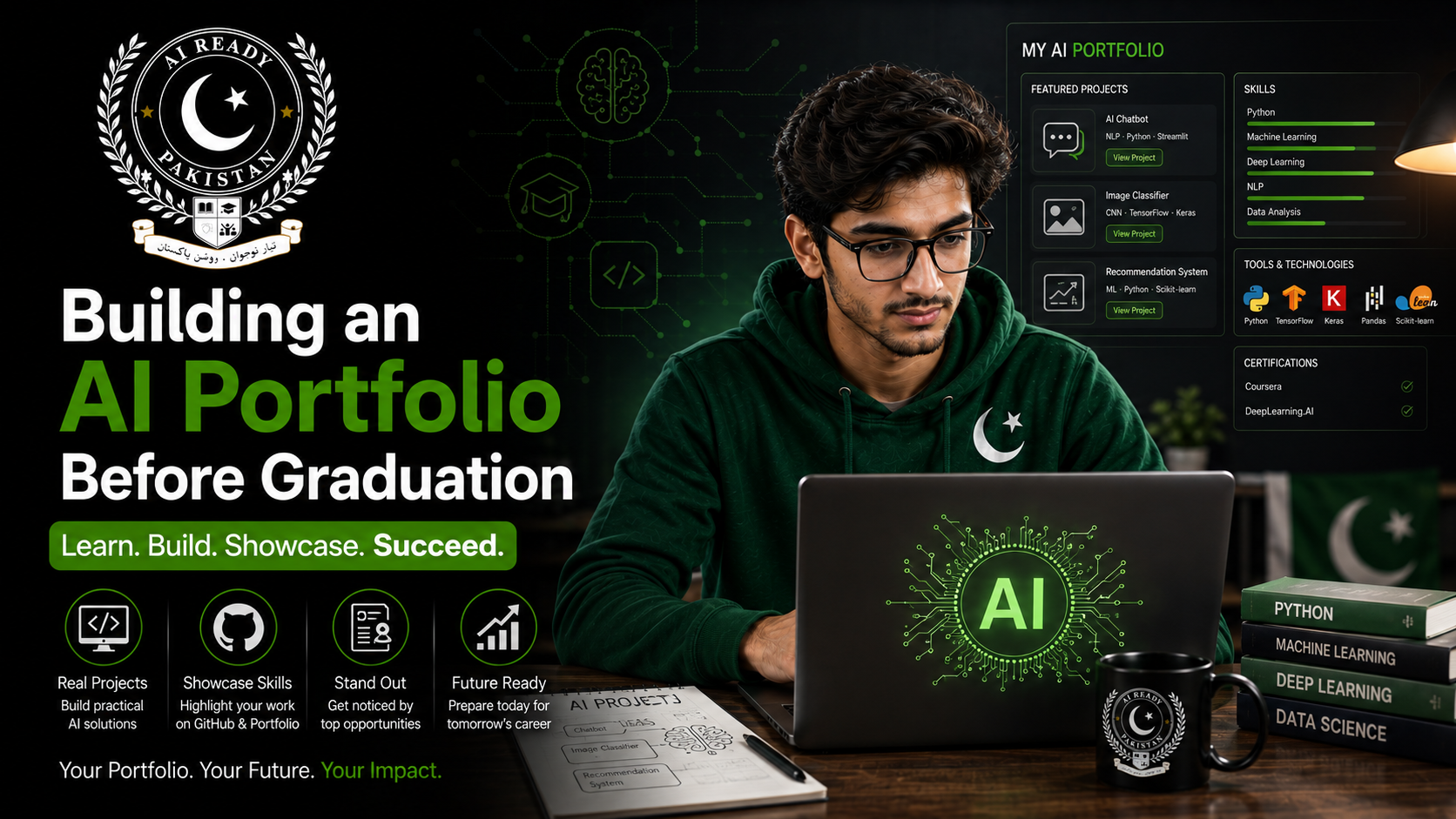
An AI portfolio is a collection of projects and practical work that shows how you’ve used AI to solve real problems. A degree tells an employer what you studied; a portfolio shows them how you apply it.
Instead of writing “I have experience with AI tools,” a portfolio can show that you built a chatbot, analyzed a dataset, or automated a repetitive task. That kind of evidence makes an application far more memorable.
This isn’t just for computer science students, either. An English Literature student could build an AI-assisted literary analysis project. A business student could analyze customer data. A marketing student could build an AI-powered content strategy. The key is connecting AI to your existing field, not switching fields entirely.
Practical Ways to Build AI Projects
You don’t need expensive tools or a dev team to start. A few accessible starting points:
1. An AI-Assisted Research Project: Pick a topic tied to your degree and use AI to support research or analysis. The key is documenting your own process and conclusions, not just asking AI to do the assignment for you.
2. A Simple Chatbot: Build something around a specific problem: a university FAQ bot, a study assistant, or a career-guidance chatbot. Even a simple version shows real problem-solving and user-focused thinking.
3. An AI Content Workflow: Document a full process (research → drafting → fact-checking → editing → publishing) and explain where AI helped and where human judgment mattered. This shows employers exactly what they care about: using AI productively without blindly trusting it.
4. Data Analysis With AI : Take a public dataset (student performance, social media trends, employment data) and use AI tools to find patterns. Document the question you asked, your methods, findings, and limitations.
Document Your Work Properly
Building something is only half the job if nobody can see it, it doesn’t count for much.
LinkedIn Share completed projects and what you actually learned building them, not just “I completed a course.” Regular posts also help build a professional identity before you’ve even graduated.
GitHub For programming or data projects, GitHub acts as a public record. A good repository includes a project description, the problem solved, tools used, and results even non-advanced programmers can use it for research or documentation-based work.
A Personal Portfolio Website Brings it all together in one place: your skills, projects, certifications, and contact info, so an employer doesn’t have to hunt across platforms.
Certifications Help But They’re Not Enough
Certifications prove you completed structured learning, which has real value. But a student with ten certificates and no projects is often less convincing than one with three certificates and a few well-documented projects. Use certifications as a foundation then turn that learning into something practical.
Internships and Real Experience
Internships expose you to actual problems classroom learning can’t replicate real teams, real deadlines, real constraints. Document what you contributed: the projects, the tools, the outcomes. Even volunteer work counts if you’re genuinely contributing.
Hackathons: Learn by Building
Hackathons force you to go from idea to working solution fast, building teamwork and problem-solving skills along the way. You don’t need to win a completed hackathon project is still a strong portfolio piece, since it shows initiative either way.
What a Strong Portfolio Actually Needs
You don’t need dozens of projects three to five strong ones beat twenty unfinished experiments. For each project, be ready to explain:
- The problem you were solving
- What you built
- How AI contributed
- Your personal role
- The result
- What you learned
- What could be improved
This structure turns a project into real evidence of learning, not just a line on a resume.
A Simple AI-Readiness Plan
You don’t need to wait until your final semester to start:
- Learn AI fundamentals and responsible use
- Pick one AI tool relevant to your field
- Build your first small project
- Document the process and results
- Publish it on LinkedIn, GitHub, or your own site
- Add relevant certifications to back it up
- Apply for internships or AI-related volunteer work
- Enter a hackathon or competition
- Build increasingly complex projects over time
- Keep your CV and portfolio updated
Conclusion
The future job market will reward people who can demonstrate real skills, not just list them. An AI portfolio gives students a way to prove their ability before graduation, turning knowledge into evidence employers can actually see.
Your degree matters. Your grades matter. But when an employer asks, “What can you actually do?” your portfolio is what answers that question.
Don’t wait until graduation to become AI-ready. Start with one skill. Build one project. Document it. Share it. Learn from what goes wrong, then build another. Your first AI project doesn’t need to be impressive it just needs to exist.
About AI Ready Pakistan
Our mission is to make every student AI-ready and professionally competitive in today’s world through limited scholarship-based training for 1,000+ students, led by top trainers.
📩 Get Involved:
🔹Become a Support Partner → https://forms.gle/q1YKKwUaUY5mps7W6
🔹 Join the Advisory Council → https://forms.gle/Hj76iXs3MkNcyabz9
📧 aireadypakistan@gmail.com | 📞 +92 315 9103387